
Permaculture principles in practice: use & value diversity
by Patrick Casey
The principle, ‘Use and Value Diversity’, is beautifully encapsulated by the age-old saying, ‘Don’t put all your eggs in one basket’.
Why do we need diversity in our systems? It’s nature’s way of building resilience, offering essential insurance against the variations of our environment—from summer dry spells to unexpected pest pressure.
We are currently building our straw bale home on a bare block—6 acres, and previously a pine plantation. Creating a design with no constraints or infrastructure in the way can be useful, but a blank slate also has its challenges and resulted in a fair bit of ‘analysis paralysis’. We’ve definitely been in the Observe & Interact phase of permaculture for a little while!
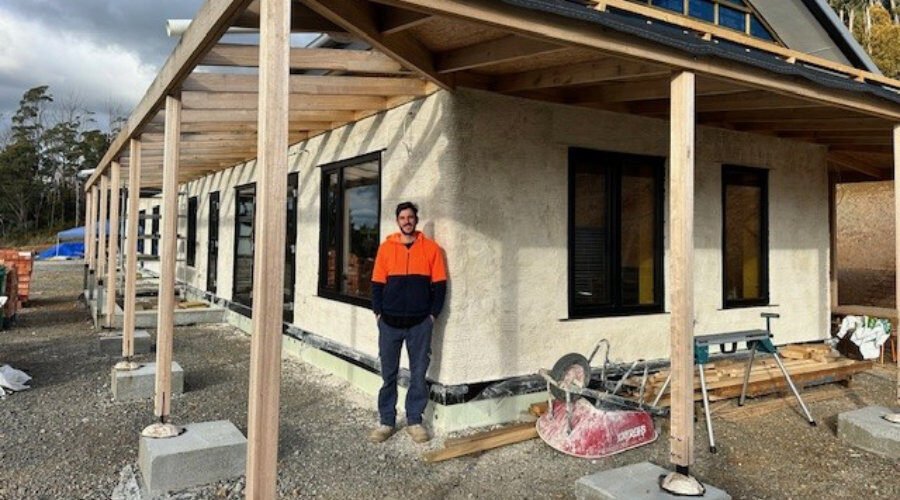
Since we had the house construction to take care of, we attended to low-hanging fruit and broadcast sowed a varied pasture mix to the bare soil. After three years of growth, we now have a mix of varied pasture, native grasses, and clumps of gorse providing habitat for small birds, wallabies, and pademelons. As John, Permaculture Tasmania’s (PT) President, often says, we have a team of full-time ground-keeping staff working the night shift keeping the grass down!
Contrast this with the risk of monoculture—if one element fails (a single crop, a single water source, a single energy supply), the whole system can fail. By diversifying our ground cover early on, we protected the soil from erosion and started the slow process of ecological restoration. In the future, we hope to add a wider range of grasses, shrubs, and small trees to increase the amount of habitat available. Our smaller marsupials, like bandicoots, and ground-nesting birds are susceptible to predation from roaming feral cats at night, and they need that dense, diverse protection to thrive. The goal for our system is clear: lots of varied habitat and food production
Diversity Beyond the Garden: Water and Community
Diversity in permaculture doesn’t always have to be about gardening and farming; it applies to all our systems. Use and value diversity could be considered as having backups, such as with the water design for our property. The house will be supplied by gravity-feed, pumped up during ‘free’ solar hours. But if we lose power or the pump fails, the gravity-feed system provides a crucial backup source to get us through until the system is repaired. This is resilience in action—avoiding reliance on a single point of failure.
In our social systems, we want to encourage resource sharing and varied skills. Where we live in Deloraine, there is a fantastic community shed where people can gather to exchange knowledge and create social connections to people with skills in construction, local ecology, preserving, art and so much more. This diverse skillset and network are a communal insurance policy—we don’t all need to be masters of everything if we can share resources and knowledge effectively.