Old knowledge made new again: Tasmania’s pre-European heritage
Book review by Russ Grayson
The knowledge of our past is the future for both Aboriginal and non-Aboriginal people living on country: Trish Hodge.
Palawa, as Tasmania’s indigenous people call themselves, have lived on the island for perhaps 40,000 years. For the last 10,000 of that immense sweep of time, since the great melting at the end of the Pleistocene ice age, they have been isolated from the mainland of the Australian continent by the waters of Bass Strait.
Through observation and interaction they built a deep knowledge of the seasons and the natural systems that sustained them. Knowledge was lost after European colonisation, but it didn’t completely disappear. Like an alpine plant in the wind and cold, it hung on in niches in the landscape. Here, below the surface of a disinterested society, it was whispered to those who needed to know.
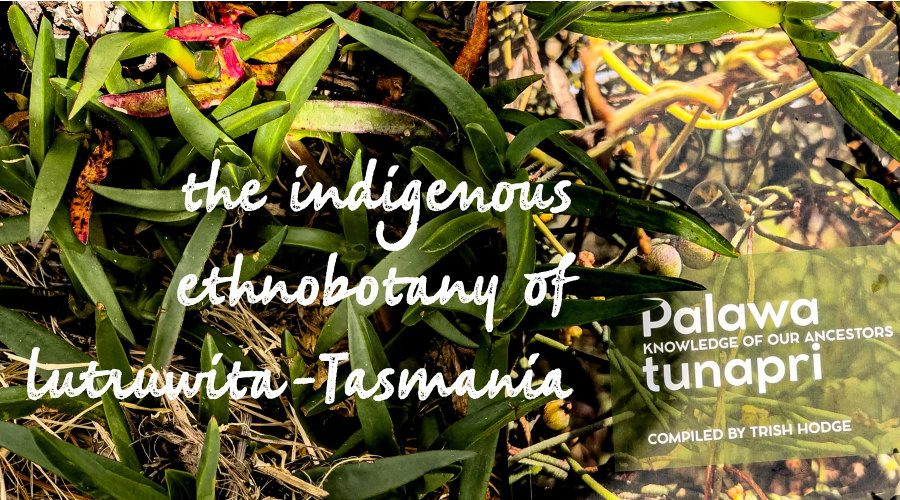
Now, change has come with a surge of interest in bush foods born of knowing that indigenous knowledge has something to teach us. When it comes to the plants of Tasmania, the island known to its indigenous people as lutruwita, Trish Hodge has much to share as she invites us to walk with her into the knowledge of her Palawa ancestors.
Palawa Tunapri: Knowledge of Our Ancestors is more than a guide to how Trish’s people made — and still make — use of the wild harvest. It is also a lesson in how the old is made new again. Knowledge, I mean. Palawa Tunapri is no ordinary plant guide. It is a book shaped by over two decades of careful research.
Not your usual ethnobotanic study
The book is not an academic taxonomic listing with botanic descriptions. Rather than simply listing plants by scientific names, Trish organises over three hundred Tasmanian species according to their cultural roles as foods, medicines and tools. They are organised into segments according to plant type: trees; shrubs; grasses, sedges and rushes;orchids and lilies; herbs, groundcover and climbers; ferns and mosses; fungi; seaweeds.
Opening the book feels like stepping into a conversation between the past and present. Photographs illustrate the plants. The descriptions echo a culture that has weathered millennia of occupation of the land. Bilingual terms introduce the Palawa language and there is even a pronunciation guide. The tone is reverential of the people of the time before, and leans more toward narrative and memory than towards analytical precision. This might not resonate with those interested in detailed botanical taxonomy, ethnobotany or anthropology or a rigorous scientific understanding of species. Still, it is knowledge drawn from observation and deduction over millennia, and in this it echoes the Western scientific method.
Palawa Tunapri is a bridge between generations, between oral tradition and the written word, between indigenous and non-indigenous peoples. It suggests that knowledge is found not only in texts and studies but in stories told around campfires and in the practice of gathering and sharing.
For anyone curious about the ways people and plants shape each other, this book is an invaluable companion. Trish writes that:
The knowledge of our past is the future for both Aboriginal and non-Aboriginal people living on country.
That is an inclusive statement. All too often, traditional cultural knowledge is presented as exclusive to its originating culture.
Who is Trish’s book for? Anyone interested in the botany of our island. Anyone interested in ethnobotany. In the plants and their value to humanity. And, of course, anyone interested in making a garden that is a little bit different. Cultivating the plants ourselves means we don’t have to take from natural systems.
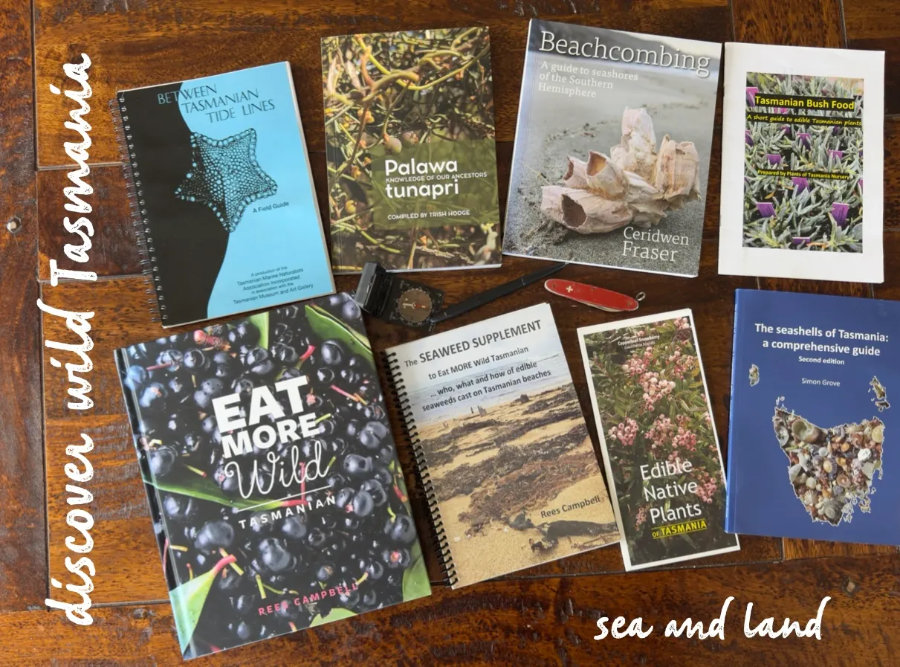
Palawa Tunapri: Knowledge of Our Ancestors joins other books of value to those who like to explore our island’s environment. Rees Campbell’s Eat Mote Wild Tasmanian and her Seaweed Supplement to the book also introduce us to Tasmania’s wild edibles. The Tasmanian Marine Naturalists Association’s Between Tasmanian Tide Lines offers us a shoreline guide to the seaweeds, shellfish and other marine creatures of our beaches. Ceridwen Fraser’s Beachcombing offers us another guide to what washes up on the shore of the ocean.
Supported by
Supported by the Kindred Spirits Fund of the Australian Garden History Society and by Hydro Tasmania, Palawa Tunapri: Knowledge of Our Ancestorswas published by Hobart’s Fullers Bookshop.
Other book reviews by Russ Grayson
- Foragers’ field guides take wild foods to the seashore books by Rees Campbell
- Wild Foods Tasmania by Rees Campbell
More reading about Tasmania’s wild foods…
- Palawa Tunapri: Knowledge of Our Ancestors; 2025, Trish Hodge; Fullers Publishing, Hobart. ISBN 978 0 86404 900 1.
- Eat More Wild Tasmanian; 2022, Rees Campbell (expanded edition); Fullers Publishing, Hobart. ISBN 978 O 6481240 0 9.
- The Seaweed Supplement (to Eat More Wild Tasmanian); 2023, Rees Campbell; Fullers Publishing, Hobart. ISBN 978 0 6483 18 098 0 000.
- Between Tasmanian Tides — a field guide; Tasmanian Marine Naturalists Association; 1999.
- Beachcombing — a guide to seashores of the southern hemisphere; 2021, Ceridwen Fraser; Otago University Press & CSIRO Australia. ISBN 078 1496 394 898.